Codeforces Round #539 (Div. 2) Problem-Solving Report (CF1113)
C - Sasha and a Bit of Relax
Actually, this problem is a total freebie. We know the condition is \(x_l \text{ xor } x_{l+1} \dots x_{mid} = x_{mid+1} \text{ xor } x_{mid+2} \dots x_{r}\), but we can move terms straight across in this operation: because \(xor\) is its own inverse. Then, to make sure \(r-l+1\) is even, we just need to maintain odd and even counts at the ends of the Trie.
// C.cpp
#include <bits/stdc++.h>
using namespace std;
const int MAX_N = 3e5 * 20 + 20000;
int trie[MAX_N][2], tot = 1, sum[MAX_N], n, even[MAX_N], odd[MAX_N];
void insert(int num, int id)
{
    int p = 1;
    for (int i = 30; i >= 0; i--)
    {
        int bit = (num >> i) & 1;
        if (trie[p][bit] == 0)
            trie[p][bit] = ++tot;
        p = trie[p][bit];
    }
    if (id & 1)
        odd[p]++;
    else
        even[p]++;
}
int find(int num)
{
    int p = 1;
    for (int i = 30; i >= 0; i--)
    {
        int bit = (num >> i) & 1;
        if (trie[p][bit] == 0)
            return -1;
        p = trie[p][bit];
    }
    return p;
}
int main()
{
    scanf("%d", &n);
    long long ans = 0;
    insert(0, 0);
    for (int r = 1; r <= n; r++)
    {
        scanf("%d", &sum[r]), sum[r] ^= sum[r - 1];
        int id = find(sum[r]);
        if (id != -1)
            if (r & 1)
                ans += odd[id];
            else
                ans += even[id];
        insert(sum[r], r);
    }
    printf("%lld", ans);
    return 0;
}
D - Sasha and One More Name
The approach to this problem is refreshingly unconventional.
First, through human wisdom we learn that the answer can only be one of three things, \(\text{no solution}, 1, 2\), and then we discuss each case:
- If some letter appears a staggering \(n-1\) or \(n\) times, we immediately rule that there is no solution.
- After that, consider enumerating the split point in \(O(n)\), cutting into a left part and a right part and splicing them back together: the left end of the left part is joined to the right end of the right part. This is easy to check. The total complexity is \(O(n^2)\).
- Whatever is left, the answer is \(2\).
// D.cpp
#include <bits/stdc++.h>
using namespace std;
const int MAX_N = 5050;
char str[MAX_N];
long long ans, n, cnt[26];

void goFuck() { printf("Impossible"), exit(0); }

int main()
{
    scanf("%s", str + 1), n = strlen(str + 1);
    char opt = str[1];
    string st = str + 1;
    for (int i = 1; i <= n; i++)
        cnt[str[i] - 'a']++;
    for (int i = 0; i < 26; i++)
        if (cnt[i] == n || cnt[i] == n - 1)
            goFuck();
    for (int i = 1; i < n; i++)
    {
        bool flag = true;
        string sub = st.substr(i) + st.substr(0, i);
        for (int pt = 0; pt < sub.length(); pt++)
            if (sub[pt] != sub[sub.length() - pt - 1])
            {
                flag = false;
                break;
            }
        if (flag && sub != st)
            printf("1"), exit(0);
    }
    printf("2");
    return 0;
}
F - Sasha and Interesting Fact from Graph Theory
This problem is really interesting.
First consider A and B lying on one chain; let's deal with the case of this chain first:
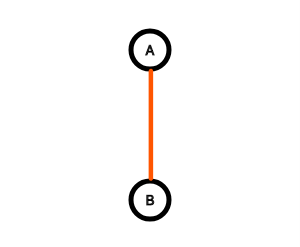
Consider that the number of points on this chain (excluding A and B) ranges over \( [0, min(n - 2, m - 1)] \); when counting the answer, we enumerate \(i\) as the number of points inside the chain (excluding A and B). Ignoring edge weights and considering only the number of points and their arrangement, there are in total:
\[ \sum_{i = 0}^{min(n - 2, m - 1)} P(n - 2, i) \]
Considering that the sum of the edge weights on the chain is always \(m\), once we maintain this property the answer becomes:
\[ \sum_{i = 0}^{min(n - 2, m - 1)} P(n - 2, i) {m - 1 \choose i} \]
Because this chain lies on the spanning tree, and the other edge weights can be chosen freely from \([1, m]\), the answer is:
\[ ans = \sum_{i = 0}^{m - 1} P(n - 2, i) * {m - 1 \choose i} * m^{n-2-i} * n^{n - 3 - i}(i+2) \]
Here we need to prove that the number of spanning trees is \(n^{n - 3 - i}(i+2)\):
Proof For this tree, we can partition the points into \(n - i - 2 + 1\) point sets: the points on the chain form one point set of size \(i + 2\), and every remaining point is a point set on its own. The number of ways to connect two point sets is \(|S_1|*|S_2|\). So in total it is:
\[ \sum_{p 为 Prufer 序列} \prod_i size[i]^{di} = \sum_{p 为 Prufer 序列} \prod_i size[i]^{di - 1} \prod size[i] \]
Because:
\[ n^{n - 2} = \sum_i d_i-1 \]
So:
\[ n^{n - 3 - i}(i+2) \]
// F.cpp
#include <bits/stdc++.h>
#define ll long long
using namespace std;
const int MAX_N = 1e6 + 2000, mod = 1e9 + 7;
ll level[MAX_N], level_rev[MAX_N], n, m, tmpx, tmpy;

ll quick_pow(ll bas, ll tim)
{
    if (tim < 0)
        return quick_pow(bas, tim + mod - 1);
    ll ans = 1;
    while (tim)
    {
        if (tim & 1)
            ans = ans * bas % mod;
        bas = bas * bas % mod;
        tim >>= 1;
    }
    return ans;
}

ll P(ll a, ll b)
{
    return level[a] * level_rev[a - b] % mod;
}

ll comb(ll a, ll b)
{
    return level[a] * level_rev[b] % mod * level_rev[a - b] % mod;
}

int main()
{
    scanf("%lld%lld%lld%lld", &n, &m, &tmpx, &tmpy);
    ll ans = 0;
    // preprocessing;
    level[1] = level_rev[1] = level[0] = level_rev[0] = 1;
    for (int i = 2; i < MAX_N; i++)
        level[i] = level[i - 1] * i % mod;
    level_rev[MAX_N - 1] = quick_pow(level[MAX_N - 1], mod - 2);
    for (int i = MAX_N - 1; i >= 3; i--)
        level_rev[i - 1] = level_rev[i] * i % mod;
    // start to calc!
    for (int i = 0; i <= min(m - 1, n - 2); i++)
        ans = (ans + P(n - 2, i) * comb(m - 1, i) % mod * quick_pow(m, n - 2 - i) % mod * quick_pow(n, n - 3 - i) % mod * (i + 2) % mod) % mod;
    printf("%lld", ans);
    return 0;
}