---
id: 1178
lang: en
translation_of: index.md
source_sha256: 5c018d9e5681a836dbf4087d81ca9e3ecf0a9e3efb9dc2ce469d96d64548fe29
title: "Codeforces Round #539 (Div. 2) Problem-Solving Report (CF1113)"
description: "XOR is its own inverse, so the condition rearranges directly; then keep odd and even counts at the ends of the Trie."
tags: ["OI","Strings","Trie","Permutations and Combinations","Counting","Combinatorics"]
translated: 2026-11-27
translator: Claude Opus 5.5
translator_model: claude-opus-5-5
translation_notes:
- "The Prufer-sequence sums keep 为 and 序列 inside the TeX subscripts as written, since only \\text{…} contents may be translated."
- "思路清奇 rendered as “refreshingly unconventional”; treated as an ordinary idiom rather than slang, so no chip (as in post 401)."
- "大水题 rendered as “a total freebie”, with the chip on the 水题 part, as in post 1950."
---
## C - Sasha and a Bit of Relax
Actually, this problem is a total freebie. We know the condition is $x_l \text{ xor } x_{l+1} \dots x_{mid} = x_{mid+1} \text{ xor } x_{mid+2} \dots x_{r}$, but we can move terms straight across in this operation: because $xor$ is its own inverse. Then, to make sure $r-l+1$ is even, we just need to maintain odd and even counts at the ends of the Trie.
```cpp
// C.cpp
#include
using namespace std;
const int MAX_N = 3e5 * 20 + 20000;
int trie[MAX_N][2], tot = 1, sum[MAX_N], n, even[MAX_N], odd[MAX_N];
void insert(int num, int id)
{
int p = 1;
for (int i = 30; i >= 0; i--)
{
int bit = (num >> i) & 1;
if (trie[p][bit] == 0)
trie[p][bit] = ++tot;
p = trie[p][bit];
}
if (id & 1)
odd[p]++;
else
even[p]++;
}
int find(int num)
{
int p = 1;
for (int i = 30; i >= 0; i--)
{
int bit = (num >> i) & 1;
if (trie[p][bit] == 0)
return -1;
p = trie[p][bit];
}
return p;
}
int main()
{
scanf("%d", &n);
long long ans = 0;
insert(0, 0);
for (int r = 1; r <= n; r++)
{
scanf("%d", &sum[r]), sum[r] ^= sum[r - 1];
int id = find(sum[r]);
if (id != -1)
if (r & 1)
ans += odd[id];
else
ans += even[id];
insert(sum[r], r);
}
printf("%lld", ans);
return 0;
}
```
## D - Sasha and One More Name
The approach to this problem is refreshingly unconventional.
First, through human wisdom we learn that the answer can only be one of three things, $\text{no solution}, 1, 2$, and then we discuss each case:
1. If some letter appears a staggering $n-1$ or $n$ times, we immediately rule that there is no solution.
2. After that, consider enumerating the split point in $O(n)$, cutting into a left part and a right part and splicing them back together: the left end of the left part is joined to the right end of the right part. This is easy to check. The total complexity is $O(n^2)$.
3. Whatever is left, the answer is $2$.
```cpp
// D.cpp
#include
using namespace std;
const int MAX_N = 5050;
char str[MAX_N];
long long ans, n, cnt[26];
void goFuck() { printf("Impossible"), exit(0); }
int main()
{
scanf("%s", str + 1), n = strlen(str + 1);
char opt = str[1];
string st = str + 1;
for (int i = 1; i <= n; i++)
cnt[str[i] - 'a']++;
for (int i = 0; i < 26; i++)
if (cnt[i] == n || cnt[i] == n - 1)
goFuck();
for (int i = 1; i < n; i++)
{
bool flag = true;
string sub = st.substr(i) + st.substr(0, i);
for (int pt = 0; pt < sub.length(); pt++)
if (sub[pt] != sub[sub.length() - pt - 1])
{
flag = false;
break;
}
if (flag && sub != st)
printf("1"), exit(0);
}
printf("2");
return 0;
}
```
## F - Sasha and Interesting Fact from Graph Theory
This problem is really interesting.
First consider A and B lying on one chain; let's deal with the case of this chain first:
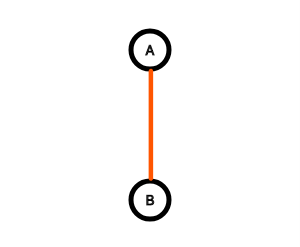
Consider that the number of points on this chain (excluding A and B) ranges over $[0, min(n - 2, m - 1)]$; when counting the answer, we enumerate $i$ as the number of points inside the chain (excluding A and B). Ignoring edge weights and considering only the number of points and their arrangement, there are in total:
$$
\sum_{i = 0}^{min(n - 2, m - 1)} P(n - 2, i)
$$
Considering that the sum of the edge weights on the chain is always $m$, once we maintain this property the answer becomes:
$$
\sum_{i = 0}^{min(n - 2, m - 1)} P(n - 2, i) {m - 1 \choose i}
$$
Because this chain lies on the spanning tree, and the other edge weights can be chosen freely from $[1, m]$, the answer is:
$$
ans = \sum_{i = 0}^{m - 1} P(n - 2, i) * {m - 1 \choose i} * m^{n-2-i} * n^{n - 3 - i}(i+2)
$$
Here we need to prove that the number of spanning trees is $n^{n - 3 - i}(i+2)$:
**Proof** For this tree, we can partition the points into $n - i - 2 + 1$ point sets: the points on the chain form one point set of size $i + 2$, and every remaining point is a point set on its own. The number of ways to connect two point sets is $|S_1|*|S_2|$. So in total it is:
$$
\sum_{p 为 Prufer 序列} \prod_i size[i]^{di} = \sum_{p 为 Prufer 序列} \prod_i size[i]^{di - 1} \prod size[i]
$$
Because:
$$
n^{n - 2} = \sum_i d_i-1
$$
So:
$$
n^{n - 3 - i}(i+2)
$$
```cpp
// F.cpp
#include
#define ll long long
using namespace std;
const int MAX_N = 1e6 + 2000, mod = 1e9 + 7;
ll level[MAX_N], level_rev[MAX_N], n, m, tmpx, tmpy;
ll quick_pow(ll bas, ll tim)
{
if (tim < 0)
return quick_pow(bas, tim + mod - 1);
ll ans = 1;
while (tim)
{
if (tim & 1)
ans = ans * bas % mod;
bas = bas * bas % mod;
tim >>= 1;
}
return ans;
}
ll P(ll a, ll b)
{
return level[a] * level_rev[a - b] % mod;
}
ll comb(ll a, ll b)
{
return level[a] * level_rev[b] % mod * level_rev[a - b] % mod;
}
int main()
{
scanf("%lld%lld%lld%lld", &n, &m, &tmpx, &tmpy);
ll ans = 0;
// preprocessing;
level[1] = level_rev[1] = level[0] = level_rev[0] = 1;
for (int i = 2; i < MAX_N; i++)
level[i] = level[i - 1] * i % mod;
level_rev[MAX_N - 1] = quick_pow(level[MAX_N - 1], mod - 2);
for (int i = MAX_N - 1; i >= 3; i--)
level_rev[i - 1] = level_rev[i] * i % mod;
// start to calc!
for (int i = 0; i <= min(m - 1, n - 2); i++)
ans = (ans + P(n - 2, i) * comb(m - 1, i) % mod * quick_pow(m, n - 2 - i) % mod * quick_pow(n, n - 3 - i) % mod * (i + 2) % mod) % mod;
printf("%lld", ans);
return 0;
}
```