AtCoder Grand Contest 032 - Problem-Solving Report
A - Limited Insertion
Here \(n \leq 100\), so consider the last insertion, and then just restore everything from there.
// A.cpp
#include <bits/stdc++.h>

using namespace std;

const int MAX_N = 110;

int n, ai[MAX_N];
vector<int> seq;

int main()
{
    bool valid = true;
    scanf("%d", &n);
    for (int i = 1; i <= n; i++)
        scanf("%d", &ai[i]), seq.push_back(ai[i]);
    stack<int> st;
    while (!seq.empty())
    {
        int pos = 0;
        for (int i = 0, siz = seq.size(); i < siz; i++)
            if (seq[i] == i + 1)
                pos = i + 1;
        if (pos == 0)
            puts("-1"), exit(0);
        seq.erase(seq.begin() + pos - 1);
        st.push(pos);
    }
    while (!st.empty())
        printf("%d\n", st.top()), st.pop();
    return 0;
}
B - Balanced Neighbors
Doodling around a bit, you find that the complete graph can achieve, for every \(i\), \(S_i = \frac{n(n + 1)}{2} - i\), so actually, if it is an even graph, we can totally drop one \(n\), that is, not connect \(n - i\). If it is an odd graph, we fix the pair sum at \(n - 1\) and just connect every vertex to \(n\).
// B.cpp
#include <bits/stdc++.h>

using namespace std;

const int MAX_N = 110;

int n;

int main()
{
    scanf("%d", &n);
    int b = n & 1;
    n -= b;
    vector<pair<int, int>> ansBox;
    for (int i = 1; i <= (n << 1); i++)
    {
        for (int j = i + 1; j <= n; j++)
            if (j != i && j != (n - i + 1))
                ansBox.push_back(make_pair(i, j));
    }
    if (b)
    {
        n += b;
        for (int i = 1; i < n; i++)
            ansBox.push_back(make_pair(i, n));
    }
    printf("%lld\n", 1LL * ansBox.size());
    for (auto x : ansBox)
        printf("%d %d\n", x.first, x.second);
    return 0;
}
C - Three Circuits
An observation problem that leaves you speechless.
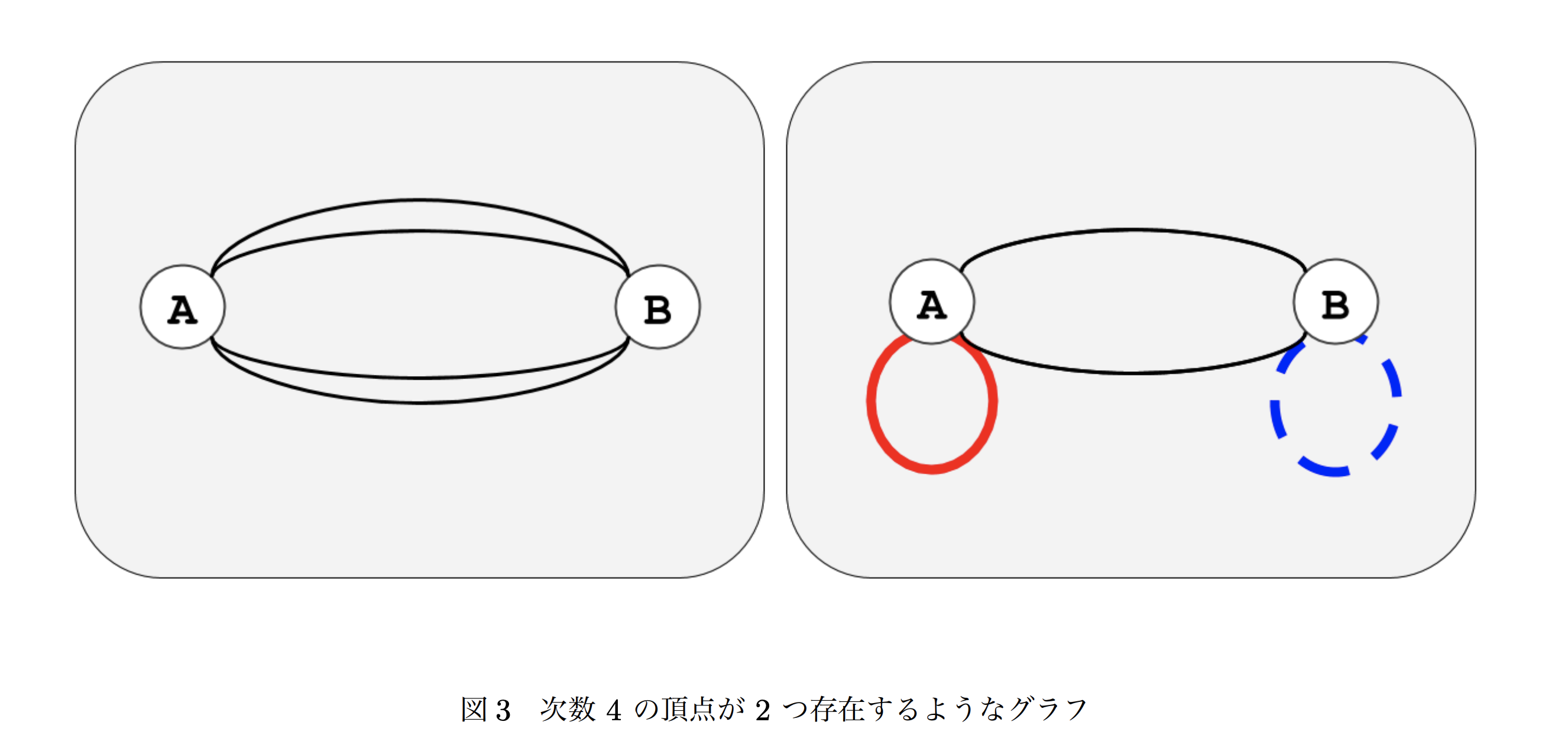
First, all degrees have to be even. Then consider the hub vertices: if the maximum degree is greater than \(4\), then obviously we can color the edges to get three Eulerian subgraphs. If the degree is \(4\), then a partition exists if the following situation occurs, otherwise it is GG:
// C.cpp
#include <bits/stdc++.h>

using namespace std;

const int MAX_N = 1e5 + 200;

int n, m, head[MAX_N], current, deg[MAX_N], A, B;
bool vis[MAX_N];

struct edge
{
    int to, nxt;
} edges[MAX_N << 1];

void addpath(int src, int dst)
{
    edges[current].to = dst, edges[current].nxt = head[src];
    head[src] = current++;
}

void dfs(int u, int fa)
{
    vis[u] = true;
    for (int i = head[u]; i != -1; i = edges[i].nxt)
        if (i != fa && edges[i].to != B)
            if (!vis[edges[i].to])
                dfs(edges[i].to, i ^ 1);
            else
                puts("Yes"), exit(0);
    vis[u] = false;
}

int main()
{
    memset(head, -1, sizeof(head));
    scanf("%d%d", &n, &m);
    for (int i = 1, u, v; i <= m; i++)
        scanf("%d%d", &u, &v), addpath(u, v), addpath(v, u), deg[u]++, deg[v]++;
    int mdeg = 0;
    for (int i = 1; i <= n; i++)
        if (deg[i] & 1)
            puts("No"), exit(0);
        else
            mdeg = max(mdeg, deg[i]);
    if (mdeg == 4)
    {
        for (int i = 1; i <= n; i++)
            if (deg[i] == 4)
                if (A == 0)
                    A = i;
                else if (B == 0)
                    B = i;
                else
                    puts("Yes"), exit(0);
        if (B)
            dfs(A, 0);
        puts("No"), exit(0);
    }
    else if (mdeg > 4)
        puts("Yes"), exit(0);
    else
        puts("No"), exit(0);
    return 0;
}
D - Rotation Sort
It is really just moving the element anywhere to its right at a cost of \(A\), and anywhere to its left at a cost of \(B\). Let's do a DP.
// D.cpp
#include <bits/stdc++.h>

using namespace std;

typedef long long ll;

const int MAX_N = 5e3 + 200;
const ll INF = 0x3f3f3f3f3f3f3f3f;

int n, A, B, pi[MAX_N], pos[MAX_N];
ll dp[MAX_N][MAX_N];

int main()
{
    scanf("%d%d%d", &n, &A, &B);
    for (int i = 1; i <= n; i++)
        scanf("%d", &pi[i]), pos[pi[i]] = i;
    memset(dp, 0x3f, sizeof(dp)), dp[0][0] = 0;
    for (int i = 1; i <= n; i++)
    {
        for (int j = 0; j < i; j++)
            if (dp[i - 1][j] != INF)
                if (pos[i] > pos[j])
                {
                    dp[i][i] = min(dp[i][i], dp[i - 1][j]);
                    dp[i][j] = min(dp[i][j], dp[i - 1][j] + B);
                }
                else
                    dp[i][j] = min(dp[i][j], dp[i - 1][j] + A);
    }
    printf("%lld\n", *min_element(dp[n], dp[n] + 1 + n));
    return 0;
}
E - Modulo Pairing
Sort first, then get a conclusion with the perturbation method: there exists a split point such that the matches in the first part are all less than \(M\), and the matches in the second part are all greater than \(M\). This point can be checked, and we want a point as far to the left as possible (greedy).
// E.cpp
#include <bits/stdc++.h>

using namespace std;

const int MAX_N = 2e5 + 200;

int n, m, ai[MAX_N];

int main()
{
    scanf("%d%d", &n, &m);
    for (int i = 1; i <= 2 * n; i++)
        scanf("%d", &ai[i]);
    sort(ai + 1, ai + 1 + 2 * n);
    int l = 0, r = n, res;
    while (l <= r)
    {
        int mid = (l + r) >> 1;
        bool valid = true;
        for (int i = 2 * mid + 1; i <= (n << 1); i++)
            if (ai[i] + ai[2 * n + 2 * mid + 1 - i] < m)
            {
                valid = false;
                break;
            }
        if (valid)
            r = mid - 1, res = mid;
        else
            l = mid + 1;
    }
    int pos = res << 1;
    int ans = 0;
    for (int i = 1; i <= pos; i++)
        ans = max(ans, ai[i] + ai[pos - i + 1]);
    for (int i = pos + 1; i <= (n << 1); i++)
        ans = max(ans, (ai[i] + ai[(n << 1) + pos - i + 1]) % m);
    printf("%lld\n", ans);
    return 0;
}