AtCoder Grand Contest 035 - Problem-Solving Report
A - XOR Circle
Consider trying every order of the only \(s \leq 3\) elements and then checking, and you're done.
// A.cpp
#include <bits/stdc++.h>

using namespace std;

const int MAX_N = 1e5 + 200;

int n, ai[MAX_N], si[MAX_N];
map<int, int> mp, tmp;

int main()
{
    scanf("%d", &n);
    for (int i = 1, x; i <= n; i++)
        scanf("%d", &ai[i]), mp[ai[i]]++;
    if (mp.size() <= 3)
    {
        vector<int> vi;
        for (auto x : mp)
            vi.push_back(x.first);
        bool flag = false;
        do
        {
            int len = vi.size();
            tmp.clear();
            for (int i = 1; i <= 2; i++)
                si[i] = vi[(i - 1) % len];
            for (int i = 3; i <= n; i++)
                si[i] = si[i - 1] ^ si[i - 2];
            for (int i = 1; i <= n; i++)
                tmp[si[i]]++;
            bool cflag = true;
            for (auto x : tmp)
                cflag &= mp[x.first] == x.second;
            flag |= cflag;
        } while (next_permutation(vi.begin(), vi.end()));
        puts(flag ? "Yes" : "No");
    }
    else
        puts("No");
    return 0;
}
B - Even Degrees
A standard-trick problem: first get a DFS tree, then greedily try to make the current subtree valid, because when the current subtree affects the parent of the subtree's root, there will also be an edge back to the parent that adjusts it. Of course, if it still doesn't work after adjusting all the way to the root, then there's definitely no solution.
// B.cpp
#include <bits/stdc++.h>

using namespace std;

const int MAX_N = 1e5 + 200;

typedef pair<int, int> pii;

int n, m, head[MAX_N], current, parity[MAX_N];
bool inst[MAX_N], vis[MAX_N];
vector<pii> ansBox;

struct edge
{
    int to, nxt;
} edges[MAX_N << 1];

void addpath(int src, int dst)
{
    edges[current].to = dst, edges[current].nxt = head[src];
    head[src] = current++;
}

bool dfs(int u, int fa)
{
    vis[u] = inst[u] = true;
    for (int i = head[u]; i != -1; i = edges[i].nxt)
        if (!vis[edges[i].to] && edges[i].to != fa)
        {
            bool res = dfs(edges[i].to, u);
            parity[u] ^= !res;
            if (res)
                ansBox.push_back(make_pair(edges[i].to, u));
            else
                ansBox.push_back(make_pair(u, edges[i].to));
        }
    inst[u] = false;
    for (int i = head[u]; i != -1; i = edges[i].nxt)
        if (inst[edges[i].to] && edges[i].to != fa)
            if (parity[u])
                parity[u] ^= 1, ansBox.push_back(make_pair(u, edges[i].to));
            else
                parity[edges[i].to] ^= 1, ansBox.push_back(make_pair(edges[i].to, u));
    return parity[u];
}

int main()
{
    memset(head, -1, sizeof(head));
    scanf("%d%d", &n, &m);
    for (int i = 1, u, v; i <= m; i++)
        scanf("%d%d", &u, &v), addpath(u, v), addpath(v, u);
    if (!dfs(1, 0))
        for (pii x : ansBox)
            printf("%d %d\n", x.first, x.second);
    else
        puts("-1");
    return 0;
}
C - Skolem XOR Tree
First, refer to the figure below:
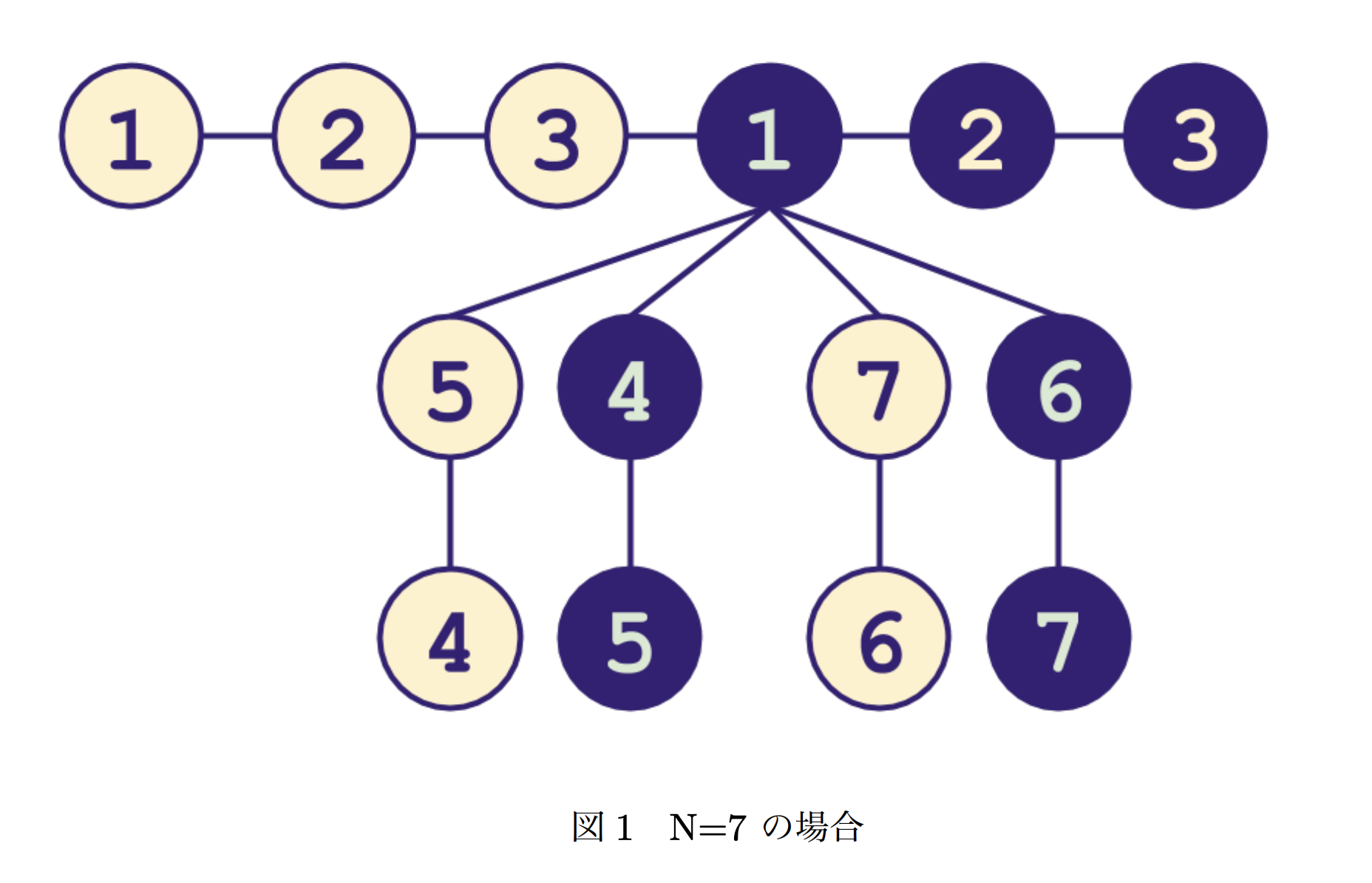
Consider the property \(2i \oplus (2i + 1) = 1\), so we can just build it this way.
If \(n\) is even, we can only get a half chain, so we consider directly enumerating the junction point on the full chain and forcibly attaching it.
// C.cpp
#include <bits/stdc++.h>

using namespace std;

const int MAX_N = 1e5 + 200;

int n;

int main()
{
    scanf("%d", &n);
    if (__builtin_popcount(n) == 1)
        puts("No"), exit(0);
    puts("Yes"), printf("1 2\n2 3\n3 %d\n%d %d\n%d %d\n", n + 1, n + 1, n + 2, n + 2, n + 3);
    for (int i = 4; i < n; i += 2)
        printf("1 %d\n%d %d\n1 %d\n%d %d\n", i, i, i + 1 + n, i + 1, i + 1, i + n);
    if (!(n & 1))
    {
        for (int i = 2; i <= n; i++)
        {
            int u = i ^ n ^ 1;
            if (i != 3 && u != 3 && u <= n)
            {
                printf("%d %d\n%d %d\n", i, n, u, 2 * n);
                break;
            }
        }
    }
    return 0;
}
D - Add and Remove
Just search.
// D.cpp
#include <bits/stdc++.h>

using namespace std;

typedef long long ll;

const ll MAX_N = 20, INF = 0x3f3f3f3f3f3f3f3f;

int n;
ll ai[MAX_N];

ll solve(int l, int r, ll cL, ll cR)
{
    if (l + 1 > r - 1)
        return 0;
    ll ret = INF;
    for (int i = l + 1; i <= r - 1; i++)
        ret = min(ret, solve(l, i, cL + cR, cR) + solve(i, r, cL, cL + cR) + 1LL * (cL + cR) * ai[i]);
    return ret;
}

int main()
{
    scanf("%d", &n);
    for (int i = 1; i <= n; i++)
        scanf("%lld", &ai[i]);
    printf("%lld\n", solve(1, n, 1, 1) + ai[1] + ai[n]);
    return 0;
}