[2018 Quanzhou National Day Training Camp #4] – Problem-Solving Report
A - Two Hearts
This problem is pure human wisdom; I really don't know how to derive it.
Expand outward from the middle, and as soon as you hit a case where \(\gcd = 1\), just output the answer.
// A.cpp
#include <bits/stdc++.h>
#define ll long long

using namespace std;

ll n, T;

ll gcd(ll a, ll b) { return b == 0 ? a : gcd(b, a % b); }

int main()
{
    scanf("%d", &T);
    while (T--)
    {
        scanf("%lld", &n);
        for (ll i = n >> 1, j = (n + 1) >> 1; i >= 1 && j <= n; i--, j++)
            if (gcd(i, j) == 1)
            {
                printf("%lld\n", i * j / gcd(i, j));
                break;
            }
    }
    return 0;
}
B - If
Doing brute force with prefix sums on this problem is really comfortable.
First compute the prefix sums, then enumerate the bottom-right point, and then enumerate \(k\), the row number of the upper rectangle:
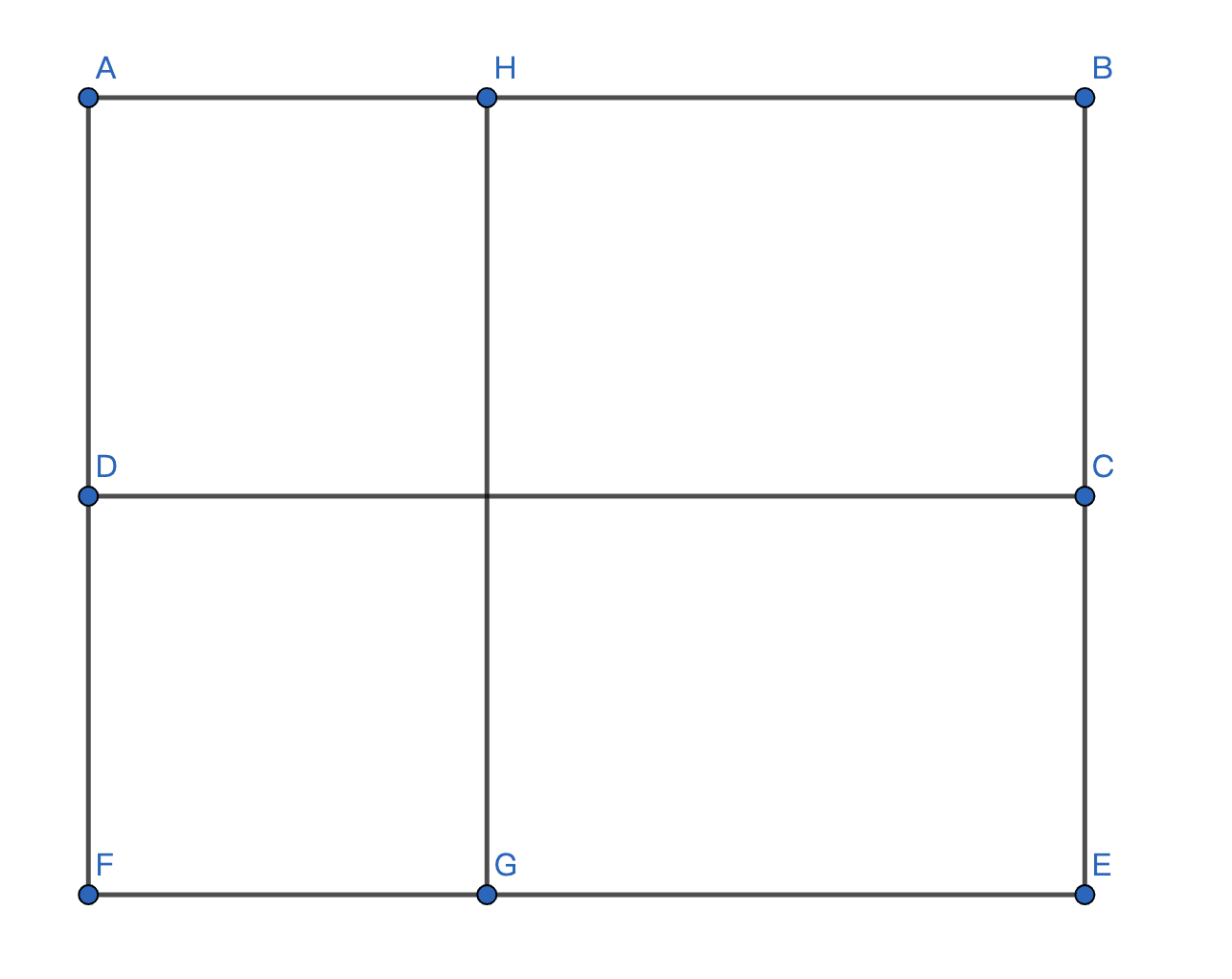
Take point \(A\) as \((0, 0)\). Then the sum of the whole subrectangle should be \(prefix[i][j] - prefix[i][k] - prefix[l][j] + prefix[l][k]\). Then, to find the maximum, we can just record the minimum of \(prefix[i][j] - prefix[k][j]\) while scanning, which squeezes in at exactly \(O(n^3)\).
// B.cpp
#include <bits/stdc++.h>

using namespace std;

const int MAX_N = 220;

int n, m, val[MAX_N][MAX_N], prefix[MAX_N][MAX_N];

int main()
{
    scanf("%d%d", &n, &m);
    for (int i = 1; i <= n; i++)
        for (int j = 1; j <= m; j++)
            scanf("%d", &val[i][j]), prefix[i][j] = prefix[i - 1][j] + prefix[i][j - 1] - prefix[i - 1][j - 1] + val[i][j];
    int mx_ans = -0x3f3f3f3f;
    for (int i = 1; i <= n; i++)
        for (int k = 0; k < i; k++)
            for (int j = 0, min_val = 0x3f3f3f3f; j <= m; j++)
            {
                min_val = min(min_val, prefix[i][j] - prefix[k][j]);
                mx_ans = max(mx_ans, prefix[i][j] - prefix[k][j] - min_val);
                continue;
            }
    printf("%d", mx_ans);
    return 0;
}
C - Lasting Long
This problem is classic CDQ divide and conquer, but I didn't figure out how exactly to do it, and then GG.
As with all CDQ divide and conquer, we solve the subproblems in the order of the original sequence. At each level we compute the contribution of the left points to the right queries, then just keep recursing.
The triangles can just be sorted the normal way: sorting by their coordinate sum as the key lets the later points be included in the queries.
// C.cpp
#include <bits/stdc++.h>

using namespace std;

const int MAX_N = 3e5 + 200;

int n, answer[MAX_N], xi[MAX_N], yi[MAX_N], xtot, ytot, tot;

struct tup
{
    int x, y, limit, val;
    bool operator<(const tup &tgt) const { return limit < tgt.limit || (limit == tgt.limit && abs(val) < abs(tgt.val)); }
} pool[MAX_N], tmp[MAX_N];

int tree1[MAX_N], tree2[MAX_N];

inline int lowbit(int x) { return x & -x; }

int query(int *arr, int x)
{
    int ans = 0;
    for (; x; x -= lowbit(x))
        ans += arr[x];
    return ans;
}

void update(int *arr, int x, int upper, int d)
{
    for (; x <= upper; x += lowbit(x))
        arr[x] += d;
}

void process(int cnt)
{
    sort(tmp + 1, tmp + 1 + cnt);
    int pt = 0;
    for (int i = 1; i <= cnt; i++)
        if (tmp[i].val != 0)
        {
            int val = abs(tmp[i].val), opt = val / tmp[i].val;
            answer[val] += opt * (pt - query(tree1, tmp[i].x) - query(tree2, tmp[i].y));
        }
        else
            pt++, update(tree1, tmp[i].x, xtot, 1), update(tree2, tmp[i].y, ytot, 1);
    for (int i = 1; i <= cnt; i++)
        if (tmp[i].val == 0)
            update(tree1, tmp[i].x, xtot, -1), update(tree2, tmp[i].y, ytot, -1);
}

void cdq(int l, int r)
{
    int mid = (l + r) >> 1, ptr1 = 0, ptr2 = 0;
    for (int i = l; i <= mid; i++)
        if (pool[i].val == 0)
            tmp[++ptr1] = pool[i];
    for (int i = mid + 1; i <= r; i++)
        if (pool[i].val != 0)
            tmp[ptr1 + (++ptr2)] = pool[i];
    if (ptr1 > 0 && ptr2 > 0)
        process(ptr1 + ptr2);
    if (ptr1 > 0 && ptr1 <= mid - l)
        cdq(l, mid);
    if (ptr2 > 0 && ptr2 < r - mid)
        cdq(mid + 1, r);
}

int main()
{
    scanf("%d", &n);
    for (int i = 1; i <= n; i++)
    {
        int x, y, d;
        scanf("%d%d%d", &x, &y, &d);
        if (d == 0)
            xi[++xtot] = x, yi[++ytot] = y, pool[++tot] = {x, y, x + y, 0}, answer[i] = -1;
        else
        {
            xi[++xtot] = x - 1, yi[++ytot] = y - 1;
            pool[++tot] = {x - 1, y - 1, x + y - 1, -i};
            pool[++tot] = {x - 1, y - 1, x + y + d, i};
        }
    }
    sort(xi + 1, xi + 1 + xtot), xtot = unique(xi + 1, xi + 1 + xtot) - xi - 1;
    sort(yi + 1, yi + 1 + ytot), ytot = unique(yi + 1, yi + 1 + ytot) - yi - 1;
    for (int i = 1; i <= tot; i++)
    {
        pool[i].x = lower_bound(xi + 1, xi + 1 + xtot, pool[i].x) - xi;
        pool[i].y = lower_bound(yi + 1, yi + 1 + ytot, pool[i].y) - yi;
    }
    cdq(1, tot);
    for (int i = 1; i <= n; i++)
        if (answer[i] >= 0)
            printf("%d\n", answer[i]);
    return 0;
}