LibreOJ 6007: [24 Network Flow Problems] Picking Numbers from a Grid — Solution
Solution
This problem can be seen as a network flow model. We color the board in red and black. Then the source connects to the red points, with the max flow capped at the red point's weight; all the black points connect to the sink, with the max flow capped at the black point's weight. The answer is the total point weight minus the max flow.
Let's try to make sense of it: for the case \(m = 1, n = 2\):
\[ [ x, y ] \]
Then suppose \(x\) is a black point and \(y\) is a red point; in the network it looks like this:
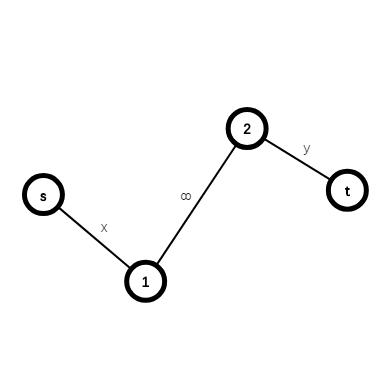
We find that the max flow only leaves the smaller of the two. That being so, we can hand-wavily generalize this to any case: the answer is just the point weight sum minus the min cut.
Code
// LOJ6007.cpp
#include <bits/stdc++.h>
using namespace std;
const int MAX_N = 10003, INF = 0x3f3f3f3f;
const int vertical[4] = {0, 1, -1, 0}, hori[4] = {1, 0, 0, -1};
int n, m, sum, head[MAX_N], current, dep[MAX_N], s, t, cur[MAX_N];
int arr[50][50], color, colors[50][50];
struct edge
{
    int to, nxt, weight;
} edges[80010];
void addpath(int src, int dst, int weight)
{
    edges[current].to = dst, edges[current].nxt = head[src];
    edges[current].weight = weight, head[src] = current++;
}
void add(int src, int dst, int weight)
{
    addpath(src, dst, weight);
    addpath(dst, src, 0);
}
bool bfs()
{
    memset(dep, 0, sizeof(dep));
    queue<int> q;
    q.push(s), dep[s] = 1;
    while (!q.empty())
    {
        int u = q.front();
        q.pop();
        for (int i = head[u]; i != -1; i = edges[i].nxt)
            if (edges[i].weight > 0 && dep[edges[i].to] == 0)
            {
                dep[edges[i].to] = dep[u] + 1;
                q.push(edges[i].to);
            }
    }
    return dep[t] != 0;
}
int dfs(int u, int flow)
{
    if (flow == 0 || u == t)
        return flow;
    for (int &i = cur[u]; i != -1; i = edges[i].nxt)
        if (dep[edges[i].to] == dep[u] + 1 && edges[i].weight > 0)
            if (int di = dfs(edges[i].to, min(flow, edges[i].weight)))
            {
                edges[i].weight -= di, edges[i ^ 1].weight += di;
                return di;
            }
    return 0;
}
int dinic()
{
    int ans = 0;
    while (bfs())
    {
        for (int i = 0; i <= t; i++)
            cur[i] = head[i];
        while (int di = dfs(s, INF))
            ans += di;
    }
    return ans;
}
int getPos(int x, int y) { return (x - 1) * m + y; }
int main()
{
    memset(head, -1, sizeof(head));
    scanf("%d%d", &n, &m);
    s = 0, t = n * m + 1;
    for (int i = 1; i <= n; i++)
        for (int j = 1; j <= m; j++)
            scanf("%d", &arr[i][j]), colors[i][j] = (i + j) & 1, sum += arr[i][j];
    for (int i = 1; i <= n; i++)
        for (int j = 1; j <= m; j++)
            if (colors[i][j] == 1)
                add(getPos(i, j), t, arr[i][j]);
            else
                add(s, getPos(i, j), arr[i][j]);
    for (int i = 1; i <= n; i++)
        for (int j = 1; j <= m; j++)
            if (colors[i][j] == 0)
                for (int dir = 0; dir < 4; dir++)
                {
                    int dstX = i + vertical[dir], dstY = j + hori[dir];
                    if (dstX > 0 && dstX <= n && dstY > 0 && dstY <= m)
                        add(getPos(i, j), getPos(dstX, dstY), INF);
                }
    int answer = sum - dinic();
    printf("%d", answer);
    return 0;
}